
La fibre optique a été l'un des principaux piliers des communications modernes. Il a une grande capacité de communication et une longue distance de transmission. Il a également l'avantage d'être très sensible et insensible aux interférences électromagnétiques. Alors, comment exactement la fibre optique transmet-elle les signaux optiques?
Conversion de signaux électriques en signaux optiques
La fibre optique est le support de transmission de signaux optiques. Et les signaux optiques sont convertis à partir de signaux électriques. Le dispositif capable de réaliser la conversion électrique et optique est appelé émetteur optique.. Dans un système à fibre optique, l'émetteur optique est le point de départ du signal de la ligne à fibre optique.
Le signal d'impulsion lumineuse est généré par une diode électroluminescente ou un laser injecté. À travers l'objectif, le signal d'impulsion lumineuse est concentré dans le support fibreux, de sorte que l'impulsion lumineuse soit transmise le long de la ligne dans le support fibreux.
Transmission du signal par fibre optique
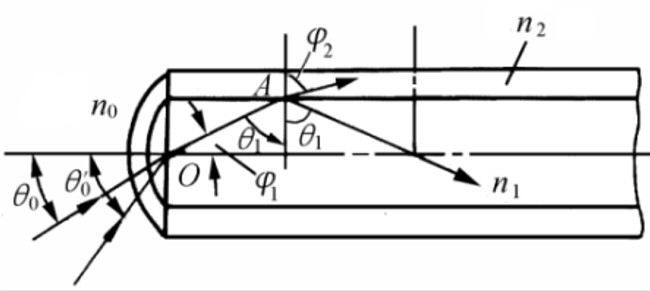
La transmission de signaux optiques (transmission de signaux optiques) est accompli par le principe de réflexion totale de la lumière. Lorsque l'angle d'incidence dépasse l'angle critique, l'impulsion lumineuse se déplace facilement le long de la ligne de fibre optique grâce à la réflexion de la lumière.
Le noyau de verre et le revêtement en verre ont tous deux une propriété inhérente, à savoir l'indice de réfraction. Il s'agit d'un paramètre fondamental qui mesure la vitesse de propagation de la lumière à travers un objet.. Pour que le système fonctionne correctement, la gaine doit avoir un indice de réfraction légèrement inférieur à celui du noyau. Cela signifie que la lumière peut voyager tout au long de la fibre selon un chemin en dents de scie..

Conversion de signaux optiques en signaux électriques
Après avoir transmis le signal optique à l'autre extrémité du système via fibre optique, le signal optique doit être converti en signal électrique. Ce n'est qu'alors que divers périphériques réseau peuvent être utilisés. L'appareil qui peut remplir cette fonction est un récepteur optique.
Le composant principal du récepteur optique est le photodétecteur. La partie la plus importante du photodétecteur est la photodiode. Il utilise le effet photoélectrique du semi-conducteur pour réduire le signal lumineux en un signal électrique. Ensuite, le signal électrique est amplifié et le signal électrique qualifié est émis via un autre traitement. Ce processus permet la restauration des signaux électriques sans pratiquement aucune atténuation..
À l'ère d'Internet, les signaux optiques sont un moyen essentiel pour effectuer la transmission d'informations. Les informations envoyées dans les communications habituelles à l'aide de téléphones portables et d'ordinateurs se présentent sous la forme de signaux électriques..
Avec un système de communication optique de base, un circuit constitué d'un émetteur optique, un récepteur optique, et une fibre optique peut être formée. Répéteurs optiques, des amplificateurs à fibre optique et des multiplexeurs par répartition en longueur d'onde sont également utilisés pour assurer la transmission du signal longue distance (transmission de signaux longue distance) qualité et augmentation de la bande passante de transmission.