
A càball smachd fo dhìon mar as trice air a chleachdadh mar loidhne ceangail ionnstramaidean dealain.
Tha e freagarrach airson loidhne ceangail ionnstramaidean dealain le bholtadh AC de 450/750V agus gu h-ìosal agus loidhne tar-chuir an t-siostam smachd fèin-ghluasadach.
Tha feartan sàr-mhath aige leithid strì an aghaidh ola, strì an aghaidh uisge, strì an aghaidh caitheamh, strì an aghaidh searbhag agus alcalan, an aghaidh diofar ghasaichean creimneach, an aghaidh aosda, agus neo-loisgteachd.
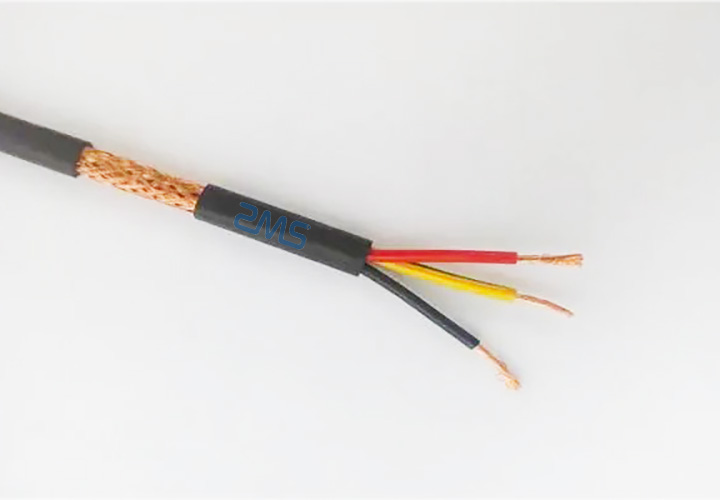
A càball smachd fo dhìon Is e càball a th’ ann le còmhdach de uèir copar no meatailt mogal air fhighe timcheall air aon uèir no barrachd. Faodaidh an sreath seo de uèir mheatailt mogal casg a chuir air stailcean dealanach agus chan urrainn dha comharran bhon taobh a-muigh bacadh a chuir air.
Tha an sgiath cuideachd a 'toirt seachad beagan dìon bho aoidionachd. Ma thèid an càball a mhilleadh rè cleachdadh agus aoidion, faodaidh an sgiath an sruth aoidionachd a stiùireadh chun uèir talmhainn, toirt seachad beagan dìon sàbhailteachd.
Is e an t-àite a th’ aig uèir dìon agus bunait càball smachd le sgiath gu bheil an còmhdach dìon air a roinn ann an dìon a-staigh agus dìon a-muigh.
Tha iad le chèile airson deagh cheangal a dhèanamh eadar an stiùiriche càball agus an còmhdach insulation, agus eadar an còmhdach insulation càball agus an còmhdach dìon a-staigh, gus cuir às don àrdachadh ann an neart raon dealain uachdar air adhbhrachadh le uachdar mì-shlaodach an stiùiriche agus an còmhdach dìon a-staigh.
Feartan toraidh de chàbaill smachd dìon.
(1) Radius cromadh ceadaichte den chàball: is e an radius cromadh as ìsle de chàball neo-armachd 6 uair an taobh a muigh trast-thomhas den chàball. Bu chòir càballan inslithe fluoroplastic agus sheathed a bhith co-dhiù 8 amannan trast-thomhas a-muigh a’ chàball. Bu chòir gum biodh co-dhiù teip copar air a chòmhdach no càball armaichte le teip stàilinn 12 amannan trast-thomhas a-muigh a’ chàball.
(2) Teòthachd obrachaidh as àirde: polytetrafluoroethylene propylene (f46) cha bu chòir insulation a bhith nas àirde 200 ℃. Polytetrafluoroethylene soluble (PFA) cha bu chòir insulation a bhith nas àirde 260 ℃.
(3) Teòthachd àrainneachd as ìsle. Còmhdach PVC: suidheachadh stèidhichte -40 ℃, suidheachadh neo-sheasmhach -15 ℃. Stuth plastaig fluorine agus còmhdach rubair silicone: suidheachadh stèidhichte -60 ℃, suidheachadh neo-sheasmhach -20 ℃. Stàladh càball agus cha bu chòir an teòthachd a bhith nas ìsle na 0 ℃ (fluoroplastic, rubair silicone agus càball sheathed nitrile cha bhith nas ìsle na -25 ℃).